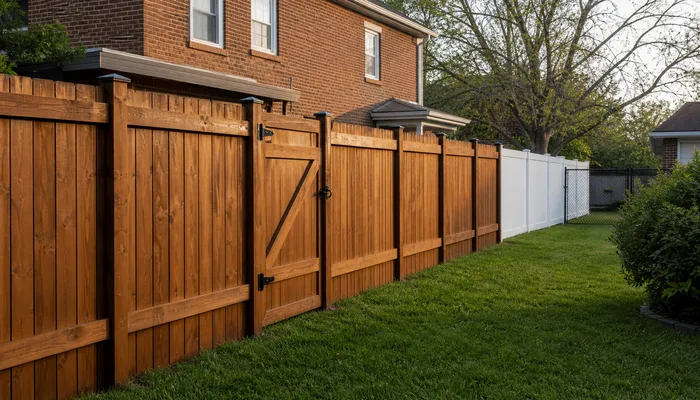
Choosing between wood, vinyl and chain link is the decision most Chicago-area property owners spend the longest weighing, and this fence material guide is written to shorten that process. The right answer rarely comes down to which panel looks best in a photograph. It comes down to how a material handles Midwestern freeze-thaw cycles, how much upkeep you are willing to take on, and what the fence actually has to do: privacy, pet containment, perimeter definition, security or curb appeal. Illinois is home to an estimated 12.69 million residents, according to ACS 2023 estimates compiled by Census Reporter, and the properties behind those fences range from narrow city lots that share an alley to industrial parcels with block-long fence lines.
That variety is exactly why a single recommendation does not hold up. A material that works behind a bungalow in Berwyn can be the wrong call for a truck yard in Bedford Park, and the fence that looks best on a front lawn in Oak Park may not be the one you want around a dog run. The comparison below covers the three material families requested most often, and the sections that follow place wrought iron, aluminum and steel in the same conversation.
Wood, Vinyl and Chain Link Compared
| Material | Where It Usually Fits | What to Plan Around |
|---|---|---|
| Wood privacy | Backyards, side yards, alley screens and driveway edges | Recurring staining or sealing, plus a plan for pickets loosened by wind and snow |
| Vinyl | Property lines where the owner wants a clean look and limited upkeep | Panel style, height and color are settled before the order is placed |
| Chain link | Pet runs, parking areas, storage yards and construction sites | Gate placement, corner posts and tension wire belong in the layout stage |
A comparison table is a starting point, not a verdict, so treat this part of the fence material guide as a filter rather than a final decision. Two neighbors on the same block can end up with different materials because one wants a solid screen while the other wants visibility, airflow and a surface that is easy to keep clean.
Why Illinois Properties Test Fence Materials Differently
Illinois is a Midwestern state that borders Lake Michigan to the northeast, the Mississippi River to the west, and the Wabash and Ohio rivers to the south, with Springfield as the capital and Chicago as its largest city (Wikipedia). For fencing, that geography translates into a specific set of working conditions: winter wind, snow, repeated freeze-thaw cycles and, in older neighborhoods, lots that sit close together with narrow or shared access.
Those conditions affect the material and the installation at the same time. Frozen ground and shifting soil influence how posts are anchored and how deep they sit, and wind exposure decides whether a tall solid panel or a more open design holds up better along an exposed side yard. Local rules add another variable: fence height, setback and permit requirements are handled municipality by municipality across the Chicago region, so it is worth confirming the rules for your address before any material is ordered.
Seasonal performance deserves its own conversation. There is a companion article on choosing the right material for Chicago weather that goes deeper into how each option behaves across a full year, which is useful background before you commit to a panel style.
Wood Privacy Fencing for Backyards and Side Yards
Wood is the material most homeowners ask about first, and in a region full of alleys, side gates and mature backyard trees, that attention makes sense. A privacy fence can screen a yard from a shared alley, define where one property ends and the next begins, block the view into a pool area, or keep a dog run separate from a vegetable garden. Boards can be replaced individually, gates can be built to match an existing style, and the finish can stay natural or be stained to complement the siding.
Project needs shift noticeably from one community to the next. In Bedford Park, where a compact residential core sits beside large industrial parcels, homeowners typically want a clean privacy line on the residential side while commercial lots call for a different approach entirely. That is why wood fence installation in Bedford Park, IL is usually planned around short runs, tight gate placement and clearly marked property boundaries.
Dense residential blocks create their own set of decisions. Cicero, with an estimated 83,223 residents, is one of the larger municipalities in the state, and its blocks are built tightly enough that accurate measurement and clean gate alignment matter more than the style of the panel. On lots like these, a privacy fence installation in Cicero, IL is designed around where the gate has to swing, where the alley access sits, and how much side yard the owner is willing to give up.
Vinyl Fencing for Property Lines With Less Upkeep
Vinyl appeals to property owners who want a defined, consistent look without a repainting or staining routine. Panels are ordered in a set color and profile, posts are set with the same layout discipline as any other material, and repairs tend to be straightforward when individual sections are damaged and need to be swapped.
Inner-ring suburbs are a natural fit for this material because side yards run short and neighbors see the same fence from several angles. Berwyn, a Cook County city of roughly 55,888 residents that grew out of the old Cicero Township, sees a steady share of replacement projects driven less by style and more by a simple calculation: how much time the owner wants to spend on upkeep each year. That is the conversation behind most vinyl fence installation in Berwyn, IL estimates, and it usually starts with height, privacy level and gate count.
Chain Link, Steel and Security Fencing for Commercial Properties
Chain link remains the workhorse of commercial and industrial fencing because it defines a boundary, guides people and vehicles toward the right entrances, and does it without blocking the sightlines a site manager needs for monitoring. It is common around parking areas, storage yards, utility enclosures, equipment pads and job sites, and it works just as well as a pet enclosure in a residential backyard.
Chicago shows why one approach does not fit every parcel. As the largest city in the state and the seat of Cook County, it mixes residential blocks, retail corridors and industrial land inside the same footprint, and each property type carries different expectations for gates, access control and perimeter height. On the commercial side, a chain link fence installation in Chicago, IL is usually scoped around vehicle turning radius, delivery routes and after-hours access, while work on the next block might simply be a fenced run for a dog.
Businesses comparing options across several sites can review the existing overview of commercial fencing options for Chicago businesses, which places fencing and gate types side by side.
Wrought Iron and Aluminum Fencing for Front Yards and Entrances
Not every fence needs to block a view. Wrought iron, aluminum and steel are chosen when the goal is definition and curb appeal rather than full screening: a front-yard boundary that stays visually open, a decorative gate at a driveway entrance, a railing along a stair, or a light perimeter around a commercial frontage. These materials also support automatic gates and access control hardware, which makes them a common answer where entry has to be managed.
Melrose Park, a suburb spanning Leyden and Proviso Townships in Cook County, illustrates how these projects often combine elements, with an open metal front section paired with a more private fence behind the house. That kind of mixed layout is why aluminum fence installation in Melrose Park, IL is typically planned in two stages, with the front line established first and the rear perimeter set afterward.
Fence Repair, Replacement and Matching an Existing Style
Not every project starts from scratch. Storm-damaged panels, leaning posts, sagging gates and fences that no longer line up with a rebuilt deck are all common reasons to call. Matching an existing fence usually comes down to three details: board or picket profile, post spacing and height. With photographs and a few measurements, a crew can tell you whether a section can be repaired, whether the run can be extended, or whether a partial rebuild will look uneven next to older material.
Oak Park, which shares a border with Chicago and was incorporated separately in 1902, has a housing mix that produces exactly this kind of request. Reach out for fence repair in Oak Park, IL and the first step is usually a look at which sections carry the load and which can simply be rebuilt in place. Routine care matters here too; the site’s fence maintenance tips cover the seasonal checks that keep small problems small.
How to Use a Fence Material Guide to Compare Estimates
A fence material guide only earns its keep if it turns into a clear scope of work, and quotes are far easier to compare when they describe the same job. Before you decide, ask each contractor to put the following in writing:
- Total linear footage, with corners and end posts counted separately
- Material, height and panel or picket profile identified by name
- Post depth and anchoring method for your soil and frost conditions
- Gate count, gate width and hardware type, including provisions for an automatic opener
- Removal and disposal of an existing fence, if one is coming out
- What is excluded, such as landscaping restoration, permit fees and utility locating
If a proposal skips the anchoring details or lists gates as a vague line item, that is worth a follow-up question. Those two items drive much of the difference between a fence that stays straight and one that starts leaning after two winters.
Working With a Local Fence Contractor
A fence project usually moves through the same sequence: a site review that looks at property lines, slope and access; measurements and a layout plan that marks posts, corners and gates; a material recommendation based on how the fence will actually be used; installation; and a final walkthrough to confirm gates swing correctly and everything lines up. Removal and disposal of an old fence can be folded into the same plan, which is far easier to handle before installation day than during it.
Chicago Fence Builders has more than 15 years of experience installing residential and commercial fencing, and the team works as licensed, bonded and insured contractors. Estimates are scheduled Monday through Saturday, 9 AM to 4 PM. Sharing your property type, approximate linear footage, gate needs and a few photos of the area helps the first conversation move quickly.
Frequently Asked Questions About Fence Materials
Is wood or vinyl better for a Chicago-area backyard?
Neither wins everywhere. Wood gives you a natural look, easy piece-by-piece repair and the option to stain a specific color. Vinyl suits owners who would rather not repaint or seal anything. Weigh sun and wind exposure, how visible the fence is from the house, and how much maintenance genuinely fits your routine.
Which fence material performs best through an Illinois winter?
Performance has more to do with installation than with one winning material. Correct post depth, anchoring planned for freeze-thaw conditions and hardware rated for the gate’s weight matter in every material family. Ask any contractor how posts are set and how gates are braced before comparing material prices.
Do I need a permit to install a fence near Chicago?
Requirements are set by each municipality and can change with height, setback and location on the lot. Confirm the rules with your local building department before ordering material. The estimate process maps your property lines and layout so you know exactly what to verify.
Can you match a fence that is already on my property?
Often, yes. Send photos along with the fence height, post spacing and gate width, and you will get an honest answer about what can be matched, repaired or replaced. Some older profiles are no longer produced, and in those cases a partial rebuild or a new run is usually the cleaner option.
Do you handle commercial fencing as well as residential work?
Yes. Residential work covers privacy, pet containment and pool-area fencing, while commercial work covers parking areas, storage yards, work sites and access control. Because the scope is so different, commercial estimates are usually scheduled as a separate site review.
How long does a fence installation take?
It depends on linear footage, terrain, access, gate count and whether an existing fence has to be removed first. Timelines are confirmed once the scope is set, rather than quoted before anyone has seen the property.
Material choice is one of the few exterior decisions that changes how a property looks and functions every single day, so it is worth getting right the first time. If you would rather start with your own address, reach Chicago Fence Builders at (773) 312-3051 or send project details through the contact page, and a site review will confirm what your layout actually needs.