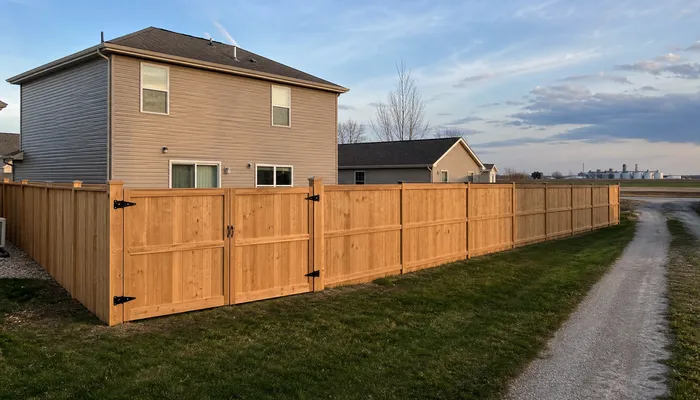
Finding the best privacy fence styles for homes in the towns immediately around Chicago O’Hare International Airport is not the same exercise as choosing a fence on a wide rural lot. Franklin Park, Northlake, Schiller Park, Itasca and Wood Dale sit across two counties, where lots are usually narrow, alleys are common, and the airport’s open ground funnels wind across backyards that were never laid out with a solid barrier in mind. This guide covers the privacy fencing choices that hold up in that setting, along with the details worth checking before any panels are ordered.
Privacy Fencing in the Shadow of O’Hare
Backyards across this cluster of suburbs share a few traits that change how a privacy fence performs. Lots tend to be compact, so a six-foot barrier can close off a yard that already feels tight. Alleys and side drives are common, which means gates get used far more often than they would on a quiet cul-de-sac. And because much of the ground near the airport is open, from runways and freight yards to parking areas and broad arterial roads, wind arrives with very little to slow it down before it reaches a residential block.
That combination is why the best privacy fence styles for homes in this area tend to lean on wind-resistant construction rather than appearance alone: heavier posts, deeper footings, and panel designs that shed part of the load instead of turning an entire fence run into a sail.
What Illinois and the Chicago Region Mean for Fence Planning
Illinois is a Midwestern state whose largest city is Chicago, in the northeastern corner near Lake Michigan, and the Chicago metropolitan area holds the largest share of the state’s residents. Population figures from the U.S. Census ACS 5-year 2023 estimates place Illinois at roughly 12.7 million people, as reflected in Census Reporter’s state profile. That density shows up in the fencing business as well: local rules change from village to village, materials are usually available quickly, and inspection timelines depend on how busy a given building department is.
The five communities in this group sit between two counties. Franklin Park, Northlake and Schiller Park are in Leyden Township, Cook County. Itasca and Wood Dale are on the DuPage County side, in Addison Township. That means at least two different building departments and two different sets of expectations for how a fence application is filed.
Five Suburbs, Five Different Yard Situations
The O’Hare corridor is not uniform, and neither are the yards behind its houses.
Wood privacy fence installation in Franklin Park, IL is the usual route for narrow side yards and back lot lines where houses sit close together. Fence contractor services in Itasca, IL reach a village roughly 25 miles northwest of downtown Chicago, close to O’Hare, major expressways and rail lines, and that layout shapes how a fence run is positioned across a yard. Residential fencing in Northlake, IL often involves alley-facing yards, where gate placement and the finished side of the fence matter as much as the panel material.
In vinyl fence installation in Schiller Park, IL, homeowners frequently want a clean look without a staining schedule, which is where low-maintenance panels earn their keep. On the western edge of the group, aluminum fence installation in Wood Dale, IL suits yards that want a defined property line without the visual weight of a solid wall of wood.
Best Privacy Fence Styles for Homes in Windy, Open Suburban Lots
Once wind exposure and tight lot lines are part of the picture, the shortlist of privacy fence styles narrows quickly.
Board-on-Board Wood Privacy Fencing
Cedar and treated pine remain the default privacy material here. A board-on-board build overlaps pickets on both sides of the rails, which closes the gaps a standard privacy fence leaves and stiffens the panel. The trade-off is weight: every post carries more load, so footing depth and post spacing matter more than a catalog photo can show.
Vinyl Privacy Fencing
Vinyl takes the freeze-thaw cycle in stride and needs no staining or sealing. The detail that separates a good vinyl fence from a frustrating one is the post-and-rail system, not the color. Heavier-walled profiles with routed posts and reinforced bottom rails hold their shape far better on a windy block than thin panels with weak connections.
Composite and Privacy Inserts
Composite boards offer a wood look with less frequent refinishing, though they typically cost more up front and move slightly with temperature swings. Where full privacy is not required, such as a side yard along a driveway, ornamental aluminum or steel fencing with privacy inserts gives a cleaner line and better visibility than a solid panel. For a side-by-side comparison of how these materials behave through a full Chicago winter, the fence material guide covering wood, vinyl and chain link goes deeper.
Height, Setback and Permit Realities in Cook and DuPage County Towns
There is no single fence code for the suburbs around O’Hare. Each village adopts its own ordinance, and the details that matter most, including maximum height, distance from the property line, what is allowed in a front yard, and whether a plat of survey is required, can change from one town to the next and sometimes from one lot type to another within the same town.
Northlake offers a clear illustration of how specific those rules can get. Its fence ordinance requires a permit before a fence is built, caps rear yard fences at a maximum height of six feet, and limits front yard and corner side yard open fencing to low heights. It also requires a fence to sit at least three inches inside the property line, restricts what can be placed in utility or drainage easements without a written agreement, and requires post-hole inspections scheduled through the Building Department at least 24 hours in advance. Fencing contractors working in the city must also be licensed, bonded and insured.
Other communities in the group apply their own versions of those limits. That is why a fence approved two towns over can still fail a plan review, and why replacing an old fence is often treated the same as building a new one. For a wider look at how height and property line limits work across this part of the region, the overview of fence height and property line rules in the northwest suburbs is a useful companion read.
Corner Lots, Alleys and the Finished-Side Question
Corner lots need separate planning. Where a yard meets two streets, a fence that looks tidy from the driveway can interfere with sight lines, and many ordinances limit how far a corner side yard fence may extend. Northlake’s code, for instance, restricts corner side yard fencing where it would project past the front yard setback of homes on the adjacent street.
The finished-side question comes up on nearly every project in this area. When a fence has a smoother face on one side and exposed rails on the other, some municipalities require the attractive side to face outward, away from the property that installed it. That detail affects how panels are ordered and how gates are framed, so it is worth settling before installation day rather than afterward.
Low-Maintenance Options and Commercial Perimeters
Not every property here is a house with a backyard. The corridor includes warehouses, storage yards, parking lots and retail frontage, and commercial work calls for a different set of decisions: chain link with privacy slats, ornamental steel or aluminum with controlled gates, and heavier posts rated for vehicle-adjacent use. Homeowners who would rather not refinish a wood fence every couple of seasons usually land on vinyl or aluminum, accepting a higher upfront cost in exchange for a predictable maintenance routine.
Posts, Frost and the Installation Detail That Decides Longevity
Fence failures in this region almost always trace back to what happened below the grass line. Frost drives deep into the soil each winter, and a post set too shallow, or in a footing that holds water, will begin to move after a couple of freeze-thaw cycles. The visible result is a gate that drags by March and panels that lean by the following spring.
Wind adds a second load. Solid privacy panels on open ground catch far more force than an ornamental fence with visible gaps, so footing depth, post spacing and rail connections matter more on privacy styles than on almost any other fence type. A thicker panel is not automatically better if the posts behind it were never sized for the weight.
Routine care is simpler than most homeowners expect: check posts and rails after the thaw, tighten hardware, keep soil and mulch from piling up against the bottom of the fence, and touch up any finish damage before winter. A seasonal routine along the lines of these fence maintenance tips will usually catch problems while they are still inexpensive to fix.
Frequently Asked Questions
Do Franklin Park, Northlake, Schiller Park, Itasca and Wood Dale follow the same fence rules?
No. Each community adopts its own fence ordinance, and the details that matter most, including height, setbacks, front yard restrictions, easements and inspection steps, can differ from one town to the next. Three of these communities are in Cook County and two are in DuPage County, and even within the same county the rules are set locally.
Which materials hold up best against O’Hare-area wind?
Any style can work if it is built for the load. The practical differences are post size, footing depth and panel weight. Board-on-board wood and heavy-wall vinyl with routed posts tend to perform well when the installation is designed for exposed conditions rather than assembled from a standard kit.
Do I need a permit to replace an old fence?
In many of these communities, yes. Replacement fencing is often treated the same as new construction, and some ordinances ask for a survey or drawing showing the proposed fence location. Confirming with the local building department before ordering materials is the safest sequence.
How close can a privacy fence sit to the property line?
That distance is set locally. Some municipalities require the entire fence to sit a minimum distance inside the property line, and fences placed on utility or drainage easements may need a written acknowledgment that the fence can be removed if access is required. A plat of survey is the most reliable way to confirm where the line actually runs.
Where do the best privacy fence styles for homes on a corner lot come from?
Corner lots usually require the most compromise. A lower or open-style barrier near the street side keeps sight lines clear, while the interior yard can carry a taller solid privacy fence. Checking local rules about how far a corner side yard fence may extend should happen before the design is finalized.
Planning a Privacy Fence Around the Airport
Projects that go smoothly in this part of Illinois tend to follow the same order: walk the property, confirm the line, check the local requirements, pick a style that matches the yard’s exposure, and only then order materials. Skipping the first three steps is how homeowners end up paying to modify or relocate a fence that was built correctly but in the wrong place.
Chicago Fence Builders handles residential and commercial fence installation and has worked in the region for more than 15 years. If you are planning a privacy fence in Franklin Park, Northlake, Schiller Park, Itasca or Wood Dale, a few details speed up the estimate: approximate linear footage, desired fence height, gate locations, whether the yard faces an alley or a corner, and any easements you already know about. Photos of the property line and the nearest cross street help too.
Call (773) 312-3051 Monday through Saturday, 9 AM to 4 PM, or send the project details through the contact page and the team can put together a scope. Each city page linked above covers local service information in more depth.