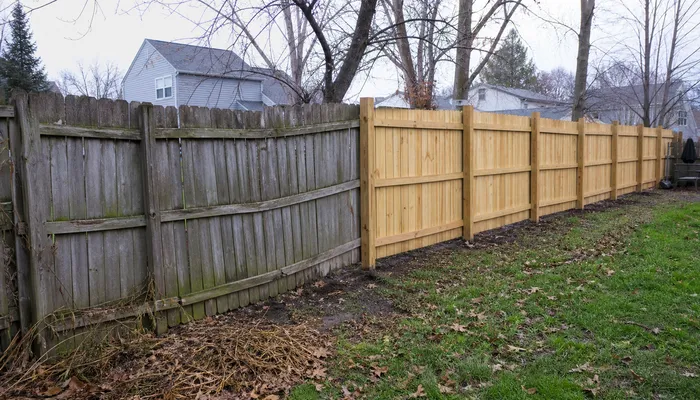
Deciding between fence repair vs. replacement rarely comes down to a single broken picket. Across Chicago’s North Shore — the lakefront blocks of Evanston, the close-packed residential lots of Skokie, the wider yards in Gurnee, and the older housing stock around Waukegan — fences fail in patterns shaped by the same forces: freeze-thaw cycles, saturated spring soils, and wind coming off Lake Michigan. This guide lays out the inspection points that actually settle the question, how material choice changes the math, and where local rules can tip a close call in one direction or the other.
Illinois is a large and varied market. The U.S. Census Bureau’s American Community Survey puts the state at roughly 12.69 million residents (2023 estimate), with Chicago as the largest city, sitting in the northeast corner of the state along the Lake Michigan shoreline. Fence conditions change with the housing stock: a 1920s two-flat and a 1990s subdivision lot usually call for different answers, even when the damage looks similar from the alley.
Why Fence Repair vs. Replacement Comes Up So Often in Northern Illinois
Fence failures here are usually progressive rather than sudden. Water works into the post hole, freezes, expands, and shifts the footing a fraction of an inch at a time. Over several winters that movement opens gaps at the rails, loosens fasteners, and keeps moisture sitting against the base of posts that are already in soil contact. Wind off the lake adds sideways load to long, unsupported runs.
Because the damage develops slowly, the honest answer depends on where the failure started. Damage that stays above the post base is usually a repair conversation. Damage that begins at or below grade is a structure conversation — and structure is what keeps gates square, panels plumb, and the whole line standing through a February thaw.
One preparation detail worth knowing before anyone digs: utility locating through JULIE/Illinois 811 is standard practice on projects that disturb the ground outside Chicago, and it happens before post holes are excavated, not after.
A Five-Point Check Before You Spend Anything
Walk the fence line and look at these five things. A phone photo of each one also makes an estimate faster and more accurate.
- Posts at the soil line. Probe the base of several posts with a screwdriver. If it sinks in easily, or the post moves when you push it, the footing is compromised.
- Rails and pickets. Look for splitting along the rail, popped fasteners, sagging mid-span, and pickets that twist out of alignment.
- Racking and alignment. A fence that leans in one direction along a run usually points to footing movement rather than a bent panel.
- Gates and hardware. Hinges, latches, and the gate post carry more stress than any other part of the fence. A gate that drags or won’t stay latched is often the first visible symptom.
- How much of the run is affected. One or two sections is a different project than a third of the fence showing the same problem.
When a Repair Is the Right Call
Repair makes sense when the failure is contained and the posts still hold. Common examples: a single panel taken out by a fallen branch, a gate that needs new hinges and a reset latch, a handful of split pickets, or a rail that pulled loose from sound posts.
With wood fencing, repairs are most straightforward when the original profile is still available — dog-eared, flat-top, or stockade pickets in a common width. Older cedar runs in established neighborhoods sometimes need custom milling to match, and that is a real cost factor worth discussing before committing to a partial fix.
Vinyl and aluminum systems are modular, so panels and posts can be swapped when the surrounding posts are undamaged. Chain link repairs are often localized too — a bent top rail, a damaged section of fabric, or a gate frame that needs re-hanging. Staying ahead of the small items is also the cheapest way to delay the bigger decision, as covered in these seasonal fence maintenance tips.
When Replacement Makes More Sense
The fence repair vs. replacement question usually tips toward replacement once the damage turns structural or repeats itself. Signals that point that direction:
- Three or more posts that move, lean, or show rot at the base.
- The same run has already been patched more than once in recent seasons.
- Racking continues along the line instead of staying at one isolated spot.
- Height or setback no longer matches current local requirements, so a repair would keep a non-conforming condition in place.
- The gate posts are failing — a gate is the heaviest load on any residential fence.
Cost per year of service is a useful way to compare the two paths. A repair that buys two seasons and then gets repeated typically costs more than a replacement that resets posts, rails, and hardware at the same time.
How Fence Material Changes the Repair-or-Replace Math
Material choice changes what the fence repair vs. replacement decision actually involves:
- Wood privacy fence. Repairable while the posts are sound; pickets and rails can be replaced individually. Rot at grade is the usual limit.
- Vinyl fence. Panels and posts are modular, so localized damage is often a straightforward swap, and the color match holds better than a patched wood section.
- Chain link fence. Fabric, rails, and gates are all replaceable components; a bent frame usually signals impact rather than age.
- Wrought iron and steel fencing. Rust at welds, footings, or the base of pickets is the deciding factor. Surface rust can often be treated; structural rust at a weld is not a repair item.
- Aluminum fence. Powder-coated aluminum resists corrosion well and individual panels can be replaced, but bent rails from impact usually mean section replacement rather than straightening.
How a material handles repeated freeze-thaw and moisture exposure is the bigger driver of long-term cost, which is the subject of our post on choosing the right material for weather.
Cook County and Lake County: What Changes From Town to Town
The four communities in this group sit in two counties and several different zoning patterns, which changes both fence design and how a repair gets scoped. Evanston and Skokie are in Cook County, where older, closer-in lots mean fence placement, height, and neighbor-facing orientation matter as much as material. Gurnee and Waukegan are in Lake County, where yards tend to be larger, runs longer, and exposure along open stretches more significant.
In practice, a repair that is routine on a half-acre lot can get complicated on a narrow parcel where the fence sits in a corner side yard or against a shared boundary. Homeowners working on wood privacy fence installation in Evanston, IL often need the finished side oriented toward the neighbor and a height that fits the yard classification. On residential fence installation in Skokie, IL, the same principles apply to a much smaller footprint, where every inch of the fence line is visible from a neighbor’s window or driveway.
On the Lake County side, longer runs in Gurnee and Waukegan put more lateral load on posts and rails, which means footing depth and post spacing carry more weight in the decision. A fence that would be a simple panel swap in a short backyard run may need two or three posts reset when the same damage appears across a long, wind-exposed line.
Permits, Inspections and Utility Locating
Fence rules in Illinois are set locally rather than by one statewide code, so the permit question has to be answered for the specific municipality and zoning district. Some towns require a permit for every fence, including a like-for-like replacement. Waukegan is a clear example: the City requires a permit for all fences including replacements, requires fence contractors to be registered with the City, and requires both post-hole inspections and a final inspection, with post holes at a minimum depth of 36 inches. The details of fence installation and replacement in Waukegan, IL are worth reviewing if your property falls in that jurisdiction, because a replacement that looks identical to the old fence can still trigger a full permit review.
Height limits also vary by yard type and district. Front yards and corner side yards are usually more restricted than rear yards, and some municipalities require ornamental, more transparent fencing in front setbacks. If your fence line crosses a front or corner side yard, height and property line requirements are worth confirming before materials are ordered — our guide to fence height and property line rules covers how these local variables typically work in the region.
When the Fence Is Part of a Business Perimeter
On commercial and multifamily properties, the repair-versus-replace decision picks up an extra variable: downtime. A compromised perimeter near a loading area, storage yard, or parking lot affects access control while work is underway, so a phased repair of specific sections is sometimes scheduled deliberately to keep an entrance open. Where the existing system has failed repeatedly, a full replacement is usually planned as one coordinated project instead of a series of patches.
Frequently Asked Questions
How do I know if my fence needs repair or a full replacement?
Start at the post bases. If posts are firm and the damage is limited to pickets, rails, or gate hardware, repair is usually the reasonable first step. If several posts move or show rot at grade, replacement is the more durable answer.
Does replacing a fence require a permit in Illinois?
It depends on the municipality. Permits and inspections are set locally, and some cities require a permit even for a replacement that matches the existing fence. Confirm the requirement with the local building department before ordering materials or scheduling work.
Can I replace only part of a fence?
Yes, when the posts and framing on either side of the damaged area are sound. A partial replacement still has to line up with the existing height, material, and profile, which is easier with common picket styles and harder with older or custom fencing.
Do all four cities in this group follow the same fence rules?
No. Evanston and Skokie are in Cook County, and Gurnee and Waukegan are in Lake County, and each municipality maintains its own fence ordinance, permit process, and inspection requirements. Height, setback, and orientation rules can differ from one town to the next.
What should I have ready when I ask for an estimate?
Photos of the damaged sections, the approximate linear footage or lot dimensions, the number of gates, the fence material, and the nearest cross street. For commercial properties, note gate locations and any access restrictions that affect scheduling.
How long should a fence last before replacement is unavoidable?
Service life depends on material, post footing, soil exposure, and maintenance. Wood in direct soil contact typically has the shortest lifespan, while powder-coated aluminum and steel systems tend to last longer when footings and hardware stay intact. A site review gives a more useful answer than a general range.
Whichever direction the inspection points, the goal is the same: spend once on the right fix. If the posts are sound, targeted repairs keep a good fence in service; if the structure is compromised, a replacement resets the clock on the parts that matter most. Property owners comparing a full rebuild can look at vinyl fence installation in Gurnee, IL as one reference point for larger yards and longer runs, while the city pages linked through this guide cover the local property context in Evanston, Skokie, and Waukegan. When you’re ready, share your fence type, approximate linear footage, gate count, and a few photos of the damage — that is usually enough to schedule a site review and scope the work clearly.
Ciudades Relacionadas De Esta Región
- Fence Installation en Evanston, IL
- Wood Privacy Fence para Gurnee, IL
- ayuda con Vinyl Fence en Skokie, IL
- servicio de Chain Link Fence en Waukegan, IL