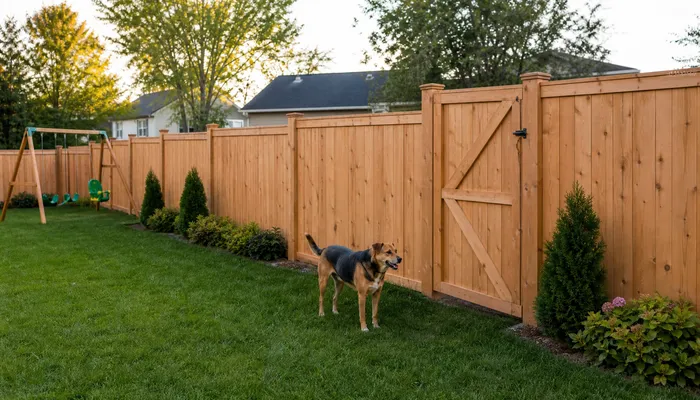
Choosing the best fences for pets and kids usually comes down to a handful of details most homeowners never think about until something goes wrong: the size of the gap between pickets, the way a gate swings shut, the space left under the bottom rail, and whether the hardware offers anything a dog can chew on or a toddler can climb. In the Fox Valley, the string of communities that follow the Fox River through McHenry and Kane counties, those details carry more weight than usual, because most backyards here are asked to do three jobs at once — a safe place for the dog, a supervised play area for the kids, and a patio or garden that still looks intentional from the street.
This guide is written for families in Algonquin, Crystal Lake, Elgin, and St. Charles who are comparing materials and want to know what actually makes a fence safer. It covers the details that matter most, how wood, vinyl, chain link, aluminum, wrought iron, and steel perform around pets and children, and what a careful installation should include.
What Fox Valley Yards Have in Common
Illinois sits in the Midwest, with Lake Michigan along its northeastern edge, and the communities in this corner of the state share a recognizable residential rhythm: established subdivisions, fenced backyards, side yards narrow enough that a gate has to be positioned carefully, and lots that frequently back up to another property rather than open land. Algonquin in McHenry County and Crystal Lake, the most populous city in that county, sit on the northern side of the Fox River corridor, while Elgin in Kane County and St. Charles sit farther south and west along the same river.
That geography matters for fencing. Ground that freezes and thaws through a northern Illinois winter moves, and a fence that was set too shallow or footed poorly will start to lean, spread at the gates, and leave gaps where panels meet posts. For households with pets and small children, those slow failures are exactly the ones that turn into escape routes.
Safety Details That Matter More Than the Style
Style is the easy part of the decision. Safety usually comes down to a few things that are hard to judge from a catalog photo.
- Height. Four feet is enough for many small and medium dogs, while strong jumpers and climbers usually need five or six feet. Maximum heights and placement rules are set locally, so confirm them with your village before ordering materials — our overview of fence height and property line rules in the northwest suburbs explains how those limits typically work.
- Picket and mesh spacing. The gap decides whether a small dog or a crawling toddler can squeeze through. Tight spacing solves most of it; if you prefer an open look, spacing has to be checked rather than assumed.
- Ground clearance. A bottom rail that sits close to grade removes the crawl space under the fence and reduces the chance a dog digs out at the lowest point of a slope.
- Gate latching. Self-closing hinges and a latch mounted above a small child’s reach do more for safety than extra fence height, because an open gate defeats the rest of the barrier.
- Hardware and surfaces. Protruding bolts, rough board ends, and staples set at pet height are common sources of scrapes and chewing. Setting fasteners flush and using smooth panels where a dog leans most often makes a difference.
- Sight lines. Solid panels block visual triggers that set off barking; open metal styles let you keep an eye on a child or dog from the kitchen window. Neither is universally better — the question is what your household needs more.
How Fox Valley Homeowners Choose the Best Fence for Pets and Kids
Material is where the decision actually happens. The best fences for pets and kids rarely come down to one universal winner — they come down to matching the material to the dog, the children, and the shape of the yard. For a side-by-side comparison of how the three most common materials handle Chicagoland weather, see this fence material guide covering wood, vinyl and chain link.
Wood Privacy Fence: The Backyard Standard
Wood remains the most common choice for family backyards. A solid six-foot run blocks the view of passing traffic and neighboring activity, which often calms a dog that barks at everything it can see, and vertical pickets can be spaced tightly enough that a small pet cannot slip through. Homeowners comparing a wood privacy fence in St. Charles often have a second goal as well: matching an existing fence line along a shared property boundary so the yard reads as one continuous barrier. The trade-off is upkeep. Wood needs sealing or staining on a schedule, and boards can warp, splinter, or loosen at the fasteners — minor details for an adult, but noticeable when a pet pushes against the same picket every day.
Vinyl Fence: Low Maintenance for Busy Households
Vinyl has become a frequent pick for families who would rather not think about their fence again for years. Panels are smooth, so there are no splinters, no staples, and no exposed fasteners at pet height, and cleaning usually amounts to a garden hose. Rigid panels also hold their shape through repeated freezes and thaws, and the smooth surface gives a dog little to grip if it tries to climb. That low-maintenance profile fits busy households in newer subdivisions, which is one reason a vinyl fence installation in Crystal Lake is so often weighed against wood for gated backyards with active dogs.
Chain Link Fence: Durable and Easy to Supervise
For large yards and dogs that need room to run, chain link is hard to beat on durability and visibility. You can see the whole yard from the door, the galvanized or coated mesh resists chewing, and repairs are usually simple when a section takes a hit. Mesh size matters more than most owners realize — a smaller weave keeps small dogs and puppies from pushing through, and gates need to sit flush with no gap beneath the frame. A chain link fence installation in Elgin is a practical fit for long property lines where a solid privacy panel would feel closed in.
Aluminum, Wrought Iron, and Steel Fencing
Open metal fencing works well wherever supervision is the priority. Aluminum and wrought iron let you see a child or a dog across the yard, and they are effectively impossible for a pet to chew through. Spacing matters more here than with solid panels: pickets need to be close enough that a small dog cannot pass between them, and the bottom rail should sit near grade. Pool surrounds, front-yard runs, and decorative front walks commonly use these styles because they look lighter from the street. Steel fencing takes the same idea into heavier-duty territory, and it is frequently used for commercial perimeters, equipment yards, and access-controlled sites. Where a property needs a mix — solid privacy along the back, open metal near the driveway — a residential fence installation in Algonquin can combine both within the same fence line.
Gates and Hardware: The Parts That Fail First
If you only inspect one part of a fence, inspect the gate. It moves more than any other section, takes the most abuse from kids and dogs, and is the first place a gap appears. Self-closing hinges, a latch that a small child cannot reach, and posts that are set deep enough to hold the gate frame square through winter all matter more than the style of the panel. For households with a pool, a gate that reliably swings shut is the single most important piece of the safety plan, and it should be tested after every season of ground movement. Driveway gates and double gates get their own check: they need to align cleanly without dragging, and the drop rod or latch has to hold in both directions.
Matching the Fence to the Yard
Two houses on the same street can need completely different fences. A narrow side yard off a driveway needs a gate placed where it will not block a car door or a trash bin. A corner lot benefits from a fence that keeps sight lines open toward the intersection. A dog run benefits from a harder surface and a tighter mesh than an open lawn. Families with toddlers usually want the pool or driveway closed off first, then the perimeter. Getting the sequence right keeps a single fence project from turning into three.
What a Careful Installation Includes
A safety fence is mostly decided before anyone digs. The process starts with a walkthrough to identify how the yard is actually used: which gate gets opened twenty times a day, where the dog patrols, where the ground slopes, and where a child’s play set will sit. From there, materials and heights are confirmed, utility locates are handled before any digging, and posts are set deep enough to stay put through freeze-and-thaw cycles rather than simply pushed into the top layer of soil. Gates are hung and adjusted at the end, then tested. With more than 15 years installing residential and commercial fencing, our crews work to the True Build-Quality Standard™ — which in practice means straight lines, secure footings, hardware that closes the same way in January as it did in July, and a final walkthrough with the homeowner before the job is called finished.
Repair and Replacement Before Small Gaps Get Bigger
Not every problem needs a new fence. A single leaning post, a gate that no longer latches, or a run of pickets broken by a falling branch are routine repair work, and fixing them quickly keeps a small fault from becoming an escape route. Replacement makes more sense when posts have heaved out of the ground across a long span, when rot has reached the rails, or when the fence is already a patchwork of mismatched sections. If you are unsure which side of that line your fence is on, our guide to the signs it is time to replace a fence walks through the warning signs in order of urgency.
Frequently Asked Questions About Pet and Child Safety Fences
What Height Works Best for Dogs and Small Children?
For most family yards, four to five feet covers small and medium dogs, while determined jumpers and climbers usually need five or six feet. Small children are safer with a self-latching gate than with extra height alone, because a tall fence slows down no one who can open a latch. Height limits are set by each municipality, so the allowed maximum can differ between Algonquin, Crystal Lake, Elgin, and St. Charles.
Which Material Holds Up Best Around Pets?
Vinyl and aluminum are easiest to live with day to day, since the surfaces are smooth and the fasteners are hidden — no splinters, nothing to chew. Wood stays the most popular choice when privacy is the priority, and chain link remains the most practical option for large yards where visibility and durability count for more than appearance.
Do I Need a Permit for a New Fence in the Fox Valley?
Most municipalities here review fence height, placement, and sometimes material before installation, and the requirements are not identical from one town to the next. We help homeowners assemble the details a village typically asks for, but the approval decision rests with the local office, not with the contractor.
Can a Failing Fence Be Repaired Instead of Replaced?
Often, yes. Sagging gates, loose pickets, and posts damaged by frost or impact are common candidates for fence repair, while widespread rot or posts that have lifted out of the ground usually cost less to replace than to patch. A quick on-site look separates the two cases in a few minutes.
What Affects the Cost of a Pet-Friendly Fence?
Linear footage, material, fence height, the number of gates, slopes and corners, and how accessible the property line is for digging all move the number. Because those factors change from yard to yard, pricing is quoted after a walkthrough rather than estimated over the phone.
Planning a Safer Yard in the Fox Valley
Every yard is a little different, and choosing the best fences for pets and kids almost always involves a short conversation about your dog’s habits, your children’s ages, and where the property line actually runs. Call (773) 312-3051 or request a fence estimate to walk the yard with a contractor. Crews are available Monday–Saturday, 9 AM – 4 PM, and work with homeowners throughout Algonquin, Crystal Lake, Elgin, and St. Charles — the community pages above cover the local details for each town.